Fuel for the mantles and the mind.

(Written in 2016)

I’m very careful when I pour the kerosene into the lamp.  I don’t ever touch the ash mantles, because we have to wait until my uncle goes to town if we want more.  I made funnel out of an old lotion container, so I could save every drop of fuel.  After filling it, I like pumping the little knob to create enough pressure in the canister that it moves upward toward the mantles and soaks them in kerosene.  I am afraid of lighting them with a match, so I always ask my oldest cousin, or my youngest uncle, both just a few years older than I am, to light it.  Once it’s lit, though, our world brightens and the toothy smiles of my cousins and I can be seen from across the room.  It’s time to read. 

Our tiny home in Sisualik, over my shoulder.

I have read every book on reloading bullets ever made, it seems.  My cousins fill their minds with MAD Magazines one of my uncles found the last time they were in town.  My aana reads her bible, again.  The younger kids read the Sears Catalogue wishing for the toys that never come.  I don’t know what I’m going to read yet, but I need to figure it out, because we don’t waste our fuel on thinking.  I grab the dictionary, I left off somewhere between synergy and syphilis, which was super gross, but still fun to read.  When it’s night time above the arctic circle, at our home without electricity, when all the wood has been chopped, all the fish has been put away, and all the sewing has been completed, we read.  For some of us, it’s a way to get away from this place.  For some of us, it’s a way to learn what an STD is.  For some of us, it’s just a way to pass time until tomorrow when the day starts over again, and we have to hekp feed 40 dogs, haul 30 gallons of water from the well, pick 5 gallons of berries, and put away more fish so we don’t starve this winter.  Every single night, we read.  Weather my grandparents or parents knew, they limited our media consumption to what was around us, what they thought was appropriate, and also what was available without electricity.
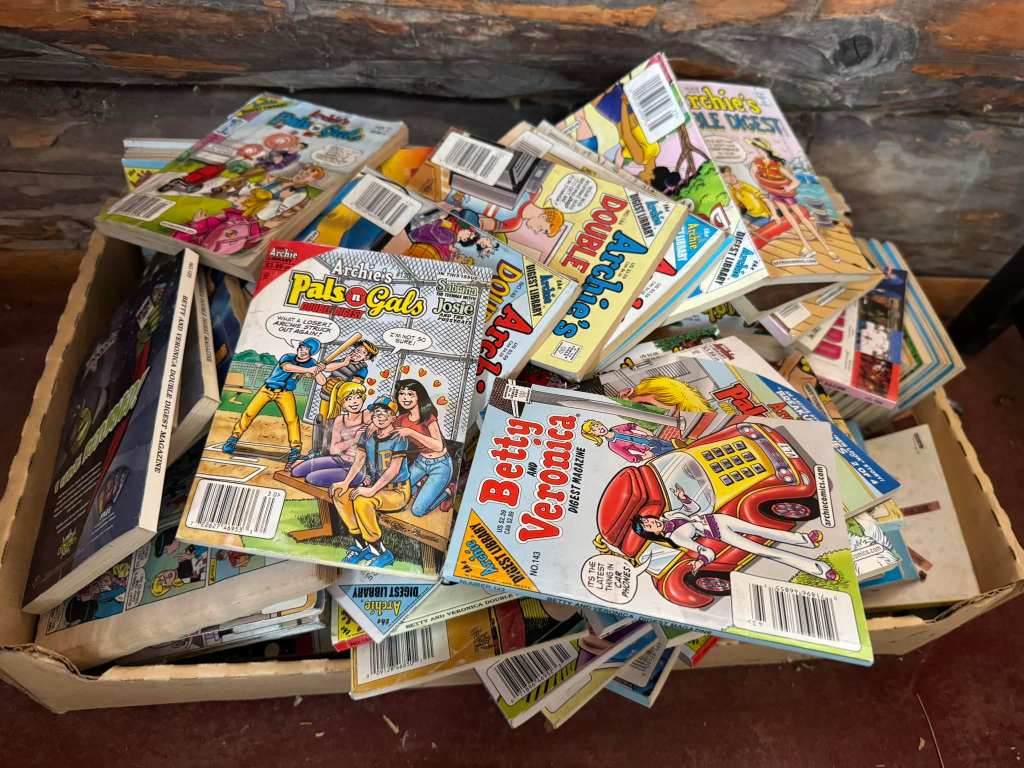
A box full of tradeable Archie comics. One comic for a can of pop.

When I was a child, I ran around with no socks and shoes on. I ran through fireweed, away from bumblebees, and picked wild onions. We stayed up late at night, bright in the midnight sun, running around the tundra playing Norwegian, kick the can, and more.”  (Lukin, M.)

 Growing up living that life is a testament to the person I’ve become, to the products I write, and the actions I do as an adult.  Every one of us who lived in that little one room house full time, or only during the spring, summer and fall read to pass the time.  We have college graduates, mayors, legislators, public servants, nurses, coaches, and more as a product of that little plywood house. 

An original Wood’s Natural History at camp.

The influences we have as a child, watching and learning from the actions around us, especially in the consumption of media, shape our decisions and paths as an adult.  Essentially living “off grid” as a child, I was exposed to simple media.  Books that my parents had, magazines that were found at garage sales, Sears and JC Penny Wish books, Archie comics, an AM Radio, a bible, and a dictionary and thesaurus.  This is culturally different than most Americans growing up in the 1980’s, when the invent of MTV came and told us, “Video killed the Radio star!”   While other kids ran around with increased access to technology, we ran around catching caribou, playing kick the can, and putting food away for winter.  The generation today has so much access to media every day of their lives that we, as adults, can’t even see the influences.  “The free, adventurous and unsupervised play outside the home that was a feature of many adults’ own childhoods is no longer a ‘normal’ part of may young children’s lived experience.”  (Browne, N.)  As Browne states, the change from unsupervised outside play to unsupervised use of technology is astounding. Parents, likely tired from increased pressure for two working parent households, don’t take the time to truly see what the internet means to children without a filter or a boundary. Kids simply don’t have the ability to limit themselves, and when parents don’t step in to set those limits, media becomes the default teacher. Children aren’t built to regulate themselves, and when adults don’t create healthy boundaries, technology fills the gap in ways we don’t fully understand yet.

My daughter, nephew and niece running to see what books we brought as they spend weeks at Sisualik with my parents.

The culture today for most Americans is one lead by social media, reality TV shows, and limiting your child’s imagination by giving them an iPad instead of crayons.  What kind of society are we building for ourselves if this is what we are giving our children?  Take a look at the current Presidential race.  We have a billionaire reality TV star as the Republican nominee, preying on the average American and trusting that social media will win this race.  We are allowing this race to shape not only our future, but our children’s characters.  As Hyatt says, “This is why we must be attentive to the input we consume.  It affects us in deep and profound ways.” (Hyatt, M.)

Grover and Charlotte read at Sisualik. Bookshelves are now filled with modern books, but you can still find reloading manuals, too.

Gone are the days where we sit down and read to our kids at night, where we go to the library as a family, and light our kerosene lamps at night so everyone can relax and read.  New media and technology take over our everyday lives.  This is not the best thing.  Social media is shaping our children’s lives in ways we can not understand yet, because it is there is little research to show.  The number of children reading declines every year more new media is introduced.  “In 1984, 8% of 13-year-olds and 9% of 17-year-olds said they “never” or “hardly ever” read for pleasure. In 2014, that number had almost tripled, to 22% and 27%. Girls also tend to read more than boys, as 18% of boys say they read daily, while 30% of girls do.  The decline in reading for fun is most easily explained by technological advances (i.e., kids would rather text than read).” (Alter, C.)

As an adult, I know without a doubt, the books and media I was exposed to shaped the adult I have become.  I read over 150 books per year, and watch little to no television.  I listen to Radio Reader and Prarie Home Companion.  The comforts I felt as a child started with the lighting of a kerosene lamp and the choosing of something to read.  I still collect Archie Comics for camp.  We still have the same dictionary and thesaurus I read as a kid, the same family bible I read over and over again (as a punishment) as well as the shot reloading manuals and National Geographic magazines.  We no longer have the Sears catalogues, but the Kindle and it’s long battery life, do make it easier to enjoy thousands of books at my fingertips.  I know I can not always limit the new media that influences my four children, but I can limit their data capability, their internet usage at home, their television time, and the books they read.  I still believe that if you put trash into your mind, trash will come out of your mouth.  They, too, have read what I read at camp, now not a home, but a place of sanctuary for us to escape the fast paced world.  We still have no electricity, and still use the same kerosene lamps we had growing up.  Though I know new media will never go away, I do work hard to create a lasting relationship with books for my children.  Like my relationship with books, it’s here to stay. 

My favorite place to read is at our homestead, in a cabin with no electricity.

Never quite enough

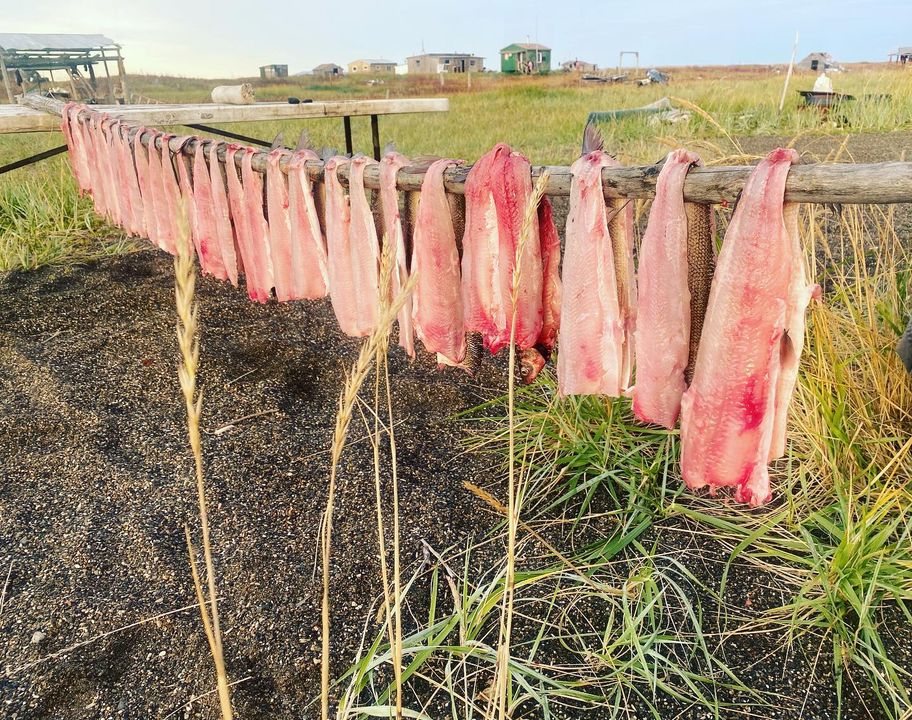
Does success really mean leaving? Leave my home. Leave my family. Leave our way of life. “EARN A DEGREE,” then come back qualified. In a system built to erase me, I knew that my education began long before I ever set foot in a college campus. It began as a child running around the spongy tundra, calculating how many berries I could fit into a gallon sized bucket, reading Archie comics under the light of a coleman lantern. My first college classroom was on the ocean. A net set full of fish, a fish rack that was built by us kids, with little to no direction from our elders, just guidance, and an understanding that we could do it becuase we watched them do it many times. My math was understanding how many containers of seal oil we would need in the Sigulaq to last all winter, for our family and extended family. My science was understanding the weather, the cloud formations and the sea ice to ensure we stayed safe. My biology was the careful dissection of countless caribou, and salmon, and whitefish, and shiifish, and ground squirrels. Pulling the tendons of the back legs of a caribou in the most efficient way was how I learned patience. Politics was a lesson on listening. Listening to the elders discuss who’s house would be built next, who would help dig a new sigluaq, and how much food we could share with people. Each of their voices carrying equal weight because this wasn’t about who could get the upper hand, this was about how to ensure the survival of our community with consensus decisions. Responsibility was taught from the moment I came into understanding that I was a part of something. Not the main focus, but a part of the survival of our family, community, culture and traditions. From the moment I could carry a driftwood log inside, I knew I was responsible for something.

My education began long before college. In a life built on observation, adaptation, resilience and survival aboe the Arctic Circle, that can’t be taught in a classroom. I didn’t just study books, or lectures, I studied the land, the migration routes of caribou and swans, understood the ice, and the oral stories meant to keep us alive explaining to me, why the things were the way they are. Every single lesson was tied to responsibility. An “Inupait Illitqusait” value. One that has since been written down, but when I was a kid, simply engrained into our very being. My education doesn’t come from a certificate. A $80,000 piece of paper that doesn’t even validate the education we already had.

I became a single parent by the age of 20. While some peers studied abroad, or lived out their college fantasies, I was responsible for my child, myself (still a child), my siblings and my grandparents. I was up all night with my son, then working full time during the day, followed by learning English 101 in the evenings. My work felt invisible because the system set up was designed to measure responsibility in terms of how many papers you had, not how many laws you changed to ensure the survival of subsistence rights. The only thing that counts, is what fits into the transcript of “accredited university.”

Early on, I realized I did not need a University to tell me I was a leader. Yet, I quickly learned that in the world built by westerners, for westerners, and about westerners, that paper means more that any lived or acted upon experience. And it’s evident still today in every Tribal entity with job openings. No where in qualifications does it say, “changed federal policy,” “negotiated complex co-stewardship agreements,” or, “advocated for subsistence rights for future generations.” The system still tells us that our knowledge is incomplete without a piece of paper framed behind us on a zoom call. The colonial measure of worth is degrees, not deeds.

One of the many policies I worked on was ensuring Indigenous Knowledge was equated to western science. That came in the form of policies for the agencies I worked with, training, and practicing what I preached. President Biden, under the Office of Science and Technology, sent a memo to ensure federal agencies did just that, (OSTP 11-15-21) and even with that direction, we still value western science more than IK in practice. Organizations still, in actions, show that the western way of doing business is the rule, rather than the exception. If our knowledge was truly equal, then why do we need a paper stamped by a university to prove what we’ve been doing has perpetuated our culture, improved our lives and protected our future? The actions of almost all “Native” organizations speak louder than their words of equality and trust. There is a huge contradiction between the celebration of Indigenous Knowledge and excluding those without a western credentialed degree.

Navigating the weight of Indigenous responsibilities to our community, our culture, our language, our kids, and even our work is exhausting. I’ve been told by many peers, they, too, had to work hard to get a degree and move up in the career ladder. I am not negating their hard work. Our hard work looks different though. Mine included teaching hundreds of kids, and thousands of community members how to correctly fillet fish, teaching alongside Inupiaq speakers, how to make a wolf ruff and why it’s important in the arctic. My hard work included taking care of aging grandparents, and nieces and nephews in my home, while taking care of my kids as well. My hard work had the weight of hundreds of generations relying on me to ensure our language and traditions don’t become history. And I was writing papers, publishing journals, doing statistics, and even taking swim yoga in college. The labor we do as perpetuators and caretakers of our culture is invisible. The system only recognizing individual achievement is a way to assimilate us, and we don’t even recognize that.

RemasterDirector_18da6b0cf

The hardest part of everything, isn’t the path itself. It’s not the work to “just finish your MS,” it’s the constant reminder that without it, I am not enough. No matter how much I do to save thousands of years of Indigenous Knowledge, protect it for future generations and work to ensure we have the tools necessary to learn it anyway, it will never be enough without that framed paper. We have all fallen victim to the world of credentials. It measures your worth and prestige. No amount of listening to elders speak, reciting oral histories, teaching sewing classes, creating tools, changing national policies, funding tribes, making changes to laws, will ever be worth as much a the letters behind your name.

I’m stuck in the middle right now. Recently losing my job, and navigating the private world of tribal institutions, I’m blown away by the western requirements. I have spent decades negotiating federal policies, working on implementing state and federal regulations to better the lives of the most affected Alaskans, advocating for the rights of subsistence users, creating policies, and implementing training programs for those in the highest form of government making decisions. I have also spent my entire life raising children, and grandchildren, teaching culture camps, working on ways to use modern tools to teach sewing, and fish filleting, and using math to teach elementary students how much water weighs in a 5 gallon bucket, perpetuating our language and traditions, and supporting others who have done that as well. Yet in both worlds there is always another test. In the western system, my accomplishments are dismissed because I didn’t follow their academic path of English 101, Math 102, and Science 105. In my Indigenous world, I am questioned for stepping too deeply into those federal spaces, and moving away from home for a job as if that erases my roots and work I still do.

It’s exhausting to be never quite enough. Having to prove legitimacy twice. Some days it feels as if I’m not native enough for my own people because I use the tools we have been given, and never Western enough for the system that was built to destroy us.

And still, I have faith that one day, one of these systems will bend, just enough so that our kids will not feel what I feel. They will be comfortable and proud to have either or both a Western education because they chose to get one, or an Indigenous education becasue they chose to stay home and provide for their family and community. And we will not judge them or diminish them for that.

The sunlight brings

When the new year comes, our family sits together and reflects on the past year, accomplishments and triumphs, and things we would have done differently. My husband and I talk about what we would like to accomplish in the coming year, and what we can do to improve our relationships, both personal and professional. We also discuss opportunities for growth.

One of those opportunities has come up for me to serve the Indigenous communities throughout the entire state, as opposed to only those in our area. A hard decision was made to accept a position at the Region 11 office for the National Park Service as the Alaska Native Tribal Relations Program Manager. That change doesn’t come lightly as we have over 16 years in our home, raising over 15 children, our own and fosters, as well as multiple years serving the community and region for Dean.

I begin my new job on March 1st. Because of the pandemic, we will stay in Kotzebue to pack our belongings, decide what’s important to us, and basically pack 20+ years of junk into totes to make a major move.

We have both learned so much from everyone in the region, the dedication on searches, the passion at subsistence meetings, the camaraderie at the Fire Department and so much more, this move is in time with our needs as a family. We want to be closer to our children, our parents and more. We want to support the tribes in another capacity, and serve other communities as we have served here.

Though bittersweet, we are looking forward to the move and if anyone has suggestions on how to get rid of 20 years of “stuff” please let us know, because we are drowning in our own stuff!

Happy New Year to everyone reading this blog post. I look forward to updating you on our move.

-Katak