
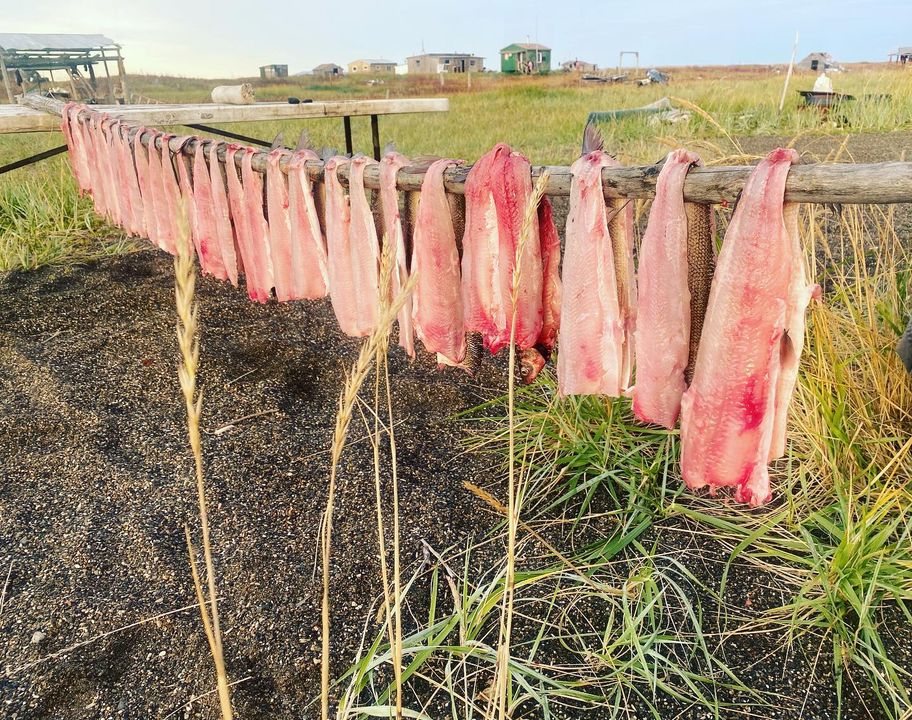
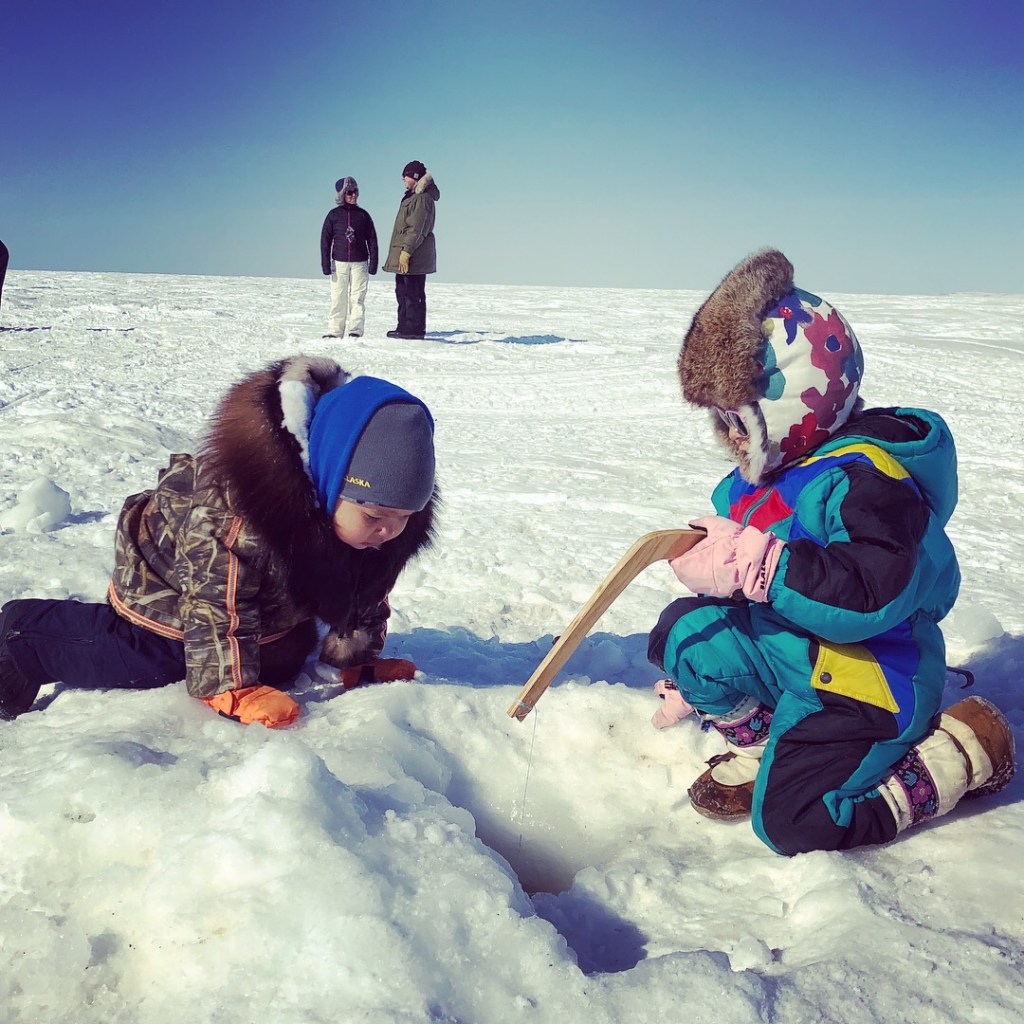
Does success really mean leaving? Leave my home. Leave my family. Leave our way of life. “EARN A DEGREE,” then come back qualified. In a system built to erase me, I knew that my education began long before I ever set foot in a college campus. It began as a child running around the spongy tundra, calculating how many berries I could fit into a gallon sized bucket, reading Archie comics under the light of a coleman lantern. My first college classroom was on the ocean. A net set full of fish, a fish rack that was built by us kids, with little to no direction from our elders, just guidance, and an understanding that we could do it becuase we watched them do it many times. My math was understanding how many containers of seal oil we would need in the Sigulaq to last all winter, for our family and extended family. My science was understanding the weather, the cloud formations and the sea ice to ensure we stayed safe. My biology was the careful dissection of countless caribou, and salmon, and whitefish, and shiifish, and ground squirrels. Pulling the tendons of the back legs of a caribou in the most efficient way was how I learned patience. Politics was a lesson on listening. Listening to the elders discuss who’s house would be built next, who would help dig a new sigluaq, and how much food we could share with people. Each of their voices carrying equal weight because this wasn’t about who could get the upper hand, this was about how to ensure the survival of our community with consensus decisions. Responsibility was taught from the moment I came into understanding that I was a part of something. Not the main focus, but a part of the survival of our family, community, culture and traditions. From the moment I could carry a driftwood log inside, I knew I was responsible for something.

My education began long before college. In a life built on observation, adaptation, resilience and survival aboe the Arctic Circle, that can’t be taught in a classroom. I didn’t just study books, or lectures, I studied the land, the migration routes of caribou and swans, understood the ice, and the oral stories meant to keep us alive explaining to me, why the things were the way they are. Every single lesson was tied to responsibility. An “Inupait Illitqusait” value. One that has since been written down, but when I was a kid, simply engrained into our very being. My education doesn’t come from a certificate. A $80,000 piece of paper that doesn’t even validate the education we already had.
I became a single parent by the age of 20. While some peers studied abroad, or lived out their college fantasies, I was responsible for my child, myself (still a child), my siblings and my grandparents. I was up all night with my son, then working full time during the day, followed by learning English 101 in the evenings. My work felt invisible because the system set up was designed to measure responsibility in terms of how many papers you had, not how many laws you changed to ensure the survival of subsistence rights. The only thing that counts, is what fits into the transcript of “accredited university.”
Early on, I realized I did not need a University to tell me I was a leader. Yet, I quickly learned that in the world built by westerners, for westerners, and about westerners, that paper means more that any lived or acted upon experience. And it’s evident still today in every Tribal entity with job openings. No where in qualifications does it say, “changed federal policy,” “negotiated complex co-stewardship agreements,” or, “advocated for subsistence rights for future generations.” The system still tells us that our knowledge is incomplete without a piece of paper framed behind us on a zoom call. The colonial measure of worth is degrees, not deeds.

One of the many policies I worked on was ensuring Indigenous Knowledge was equated to western science. That came in the form of policies for the agencies I worked with, training, and practicing what I preached. President Biden, under the Office of Science and Technology, sent a memo to ensure federal agencies did just that, (OSTP 11-15-21) and even with that direction, we still value western science more than IK in practice. Organizations still, in actions, show that the western way of doing business is the rule, rather than the exception. If our knowledge was truly equal, then why do we need a paper stamped by a university to prove what we’ve been doing has perpetuated our culture, improved our lives and protected our future? The actions of almost all “Native” organizations speak louder than their words of equality and trust. There is a huge contradiction between the celebration of Indigenous Knowledge and excluding those without a western credentialed degree.

Navigating the weight of Indigenous responsibilities to our community, our culture, our language, our kids, and even our work is exhausting. I’ve been told by many peers, they, too, had to work hard to get a degree and move up in the career ladder. I am not negating their hard work. Our hard work looks different though. Mine included teaching hundreds of kids, and thousands of community members how to correctly fillet fish, teaching alongside Inupiaq speakers, how to make a wolf ruff and why it’s important in the arctic. My hard work included taking care of aging grandparents, and nieces and nephews in my home, while taking care of my kids as well. My hard work had the weight of hundreds of generations relying on me to ensure our language and traditions don’t become history. And I was writing papers, publishing journals, doing statistics, and even taking swim yoga in college. The labor we do as perpetuators and caretakers of our culture is invisible. The system only recognizing individual achievement is a way to assimilate us, and we don’t even recognize that.
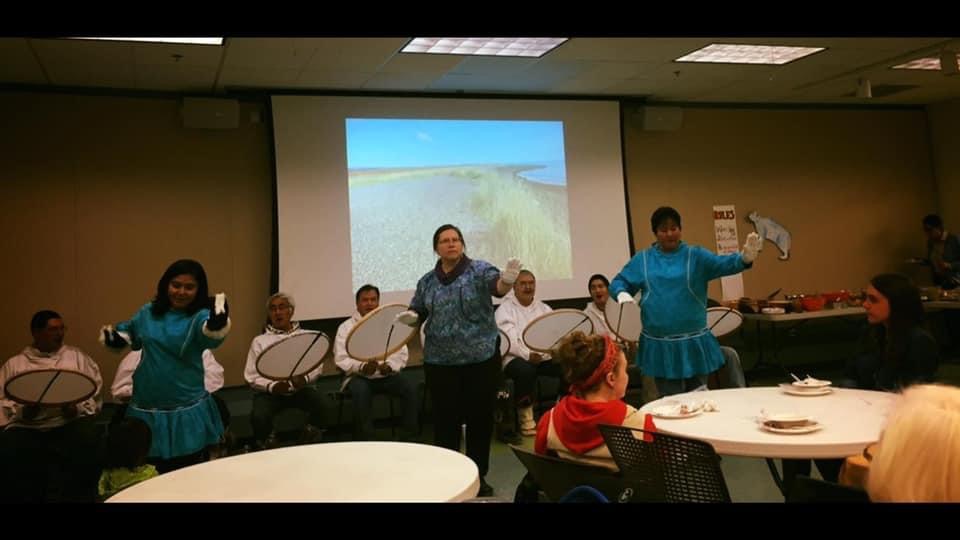
The hardest part of everything, isn’t the path itself. It’s not the work to “just finish your MS,” it’s the constant reminder that without it, I am not enough. No matter how much I do to save thousands of years of Indigenous Knowledge, protect it for future generations and work to ensure we have the tools necessary to learn it anyway, it will never be enough without that framed paper. We have all fallen victim to the world of credentials. It measures your worth and prestige. No amount of listening to elders speak, reciting oral histories, teaching sewing classes, creating tools, changing national policies, funding tribes, making changes to laws, will ever be worth as much a the letters behind your name.

I’m stuck in the middle right now. Recently losing my job, and navigating the private world of tribal institutions, I’m blown away by the western requirements. I have spent decades negotiating federal policies, working on implementing state and federal regulations to better the lives of the most affected Alaskans, advocating for the rights of subsistence users, creating policies, and implementing training programs for those in the highest form of government making decisions. I have also spent my entire life raising children, and grandchildren, teaching culture camps, working on ways to use modern tools to teach sewing, and fish filleting, and using math to teach elementary students how much water weighs in a 5 gallon bucket, perpetuating our language and traditions, and supporting others who have done that as well. Yet in both worlds there is always another test. In the western system, my accomplishments are dismissed because I didn’t follow their academic path of English 101, Math 102, and Science 105. In my Indigenous world, I am questioned for stepping too deeply into those federal spaces, and moving away from home for a job as if that erases my roots and work I still do.

It’s exhausting to be never quite enough. Having to prove legitimacy twice. Some days it feels as if I’m not native enough for my own people because I use the tools we have been given, and never Western enough for the system that was built to destroy us.
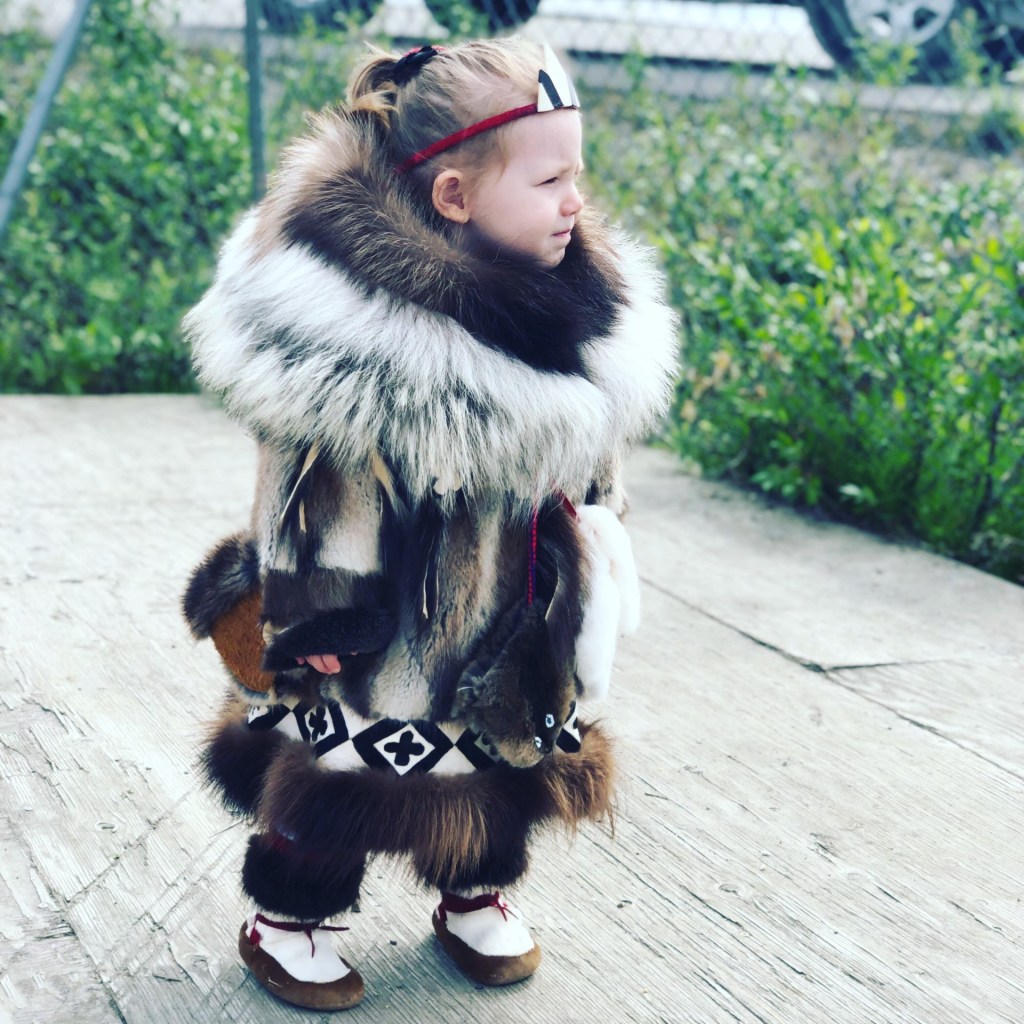
And still, I have faith that one day, one of these systems will bend, just enough so that our kids will not feel what I feel. They will be comfortable and proud to have either or both a Western education because they chose to get one, or an Indigenous education becasue they chose to stay home and provide for their family and community. And we will not judge them or diminish them for that.
 Maija Katak Lukin